
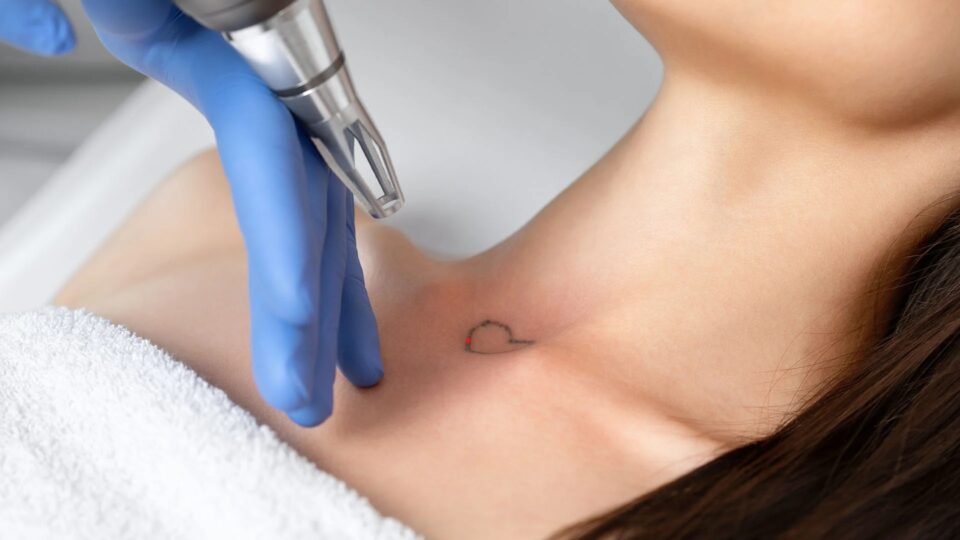
Tattoo removal, pigmented lesion therapy, and skin resurfacing/rejuvenation are all made easier with the Pico Discovery Series, the first “second generation” picosecond Nd: YAG laser.
With up to three wavelength options (532 nm, 1064 nm, and 694 nm), high peak power, and up to four emission modes, this laser series combines optimal performance with a comprehensive set of therapeutic options.
What Is The Function?
Q-Switched lasers are still the gold standard for tattoo removal. Still, picosecond technology has made the process more comfortable, faster, and effective for some tattoo types while reducing others’ permanence.
Tattoo ink particles are heated and broken up using Q-switched laser radiation, allowing the body to eliminate the tattoo quickly. Picosecond lasers, such as the Pico Series devices, are far superior to other lasers for tattoo removal because they don’t rely on heat to perform their work. Instead, they employ ultra-short laser pulses to bombard the ink particles at very high pressure, creating what’s known as a photoacoustic effect, which results in much less discomfort for the patient. Shattering into microscopic fragments, the ink disintegrates. When this happens, the particles are absorbed considerably more rapidly and easily, and the body gets rid of them normally.
The Discovery Pico devices (532 nm and 1064 nm) emit light at two different wavelengths, can generate picosecond and nanosecond pulses, and feature a free-running mode, allowing for the treatment of a wide range of tattoo colors and pigmentation depths on a variety of skin tones simply by switching the laser energy delivery mode used during sessions. The same holds when trying to eliminate age spots or other pigmented lesions or rejuvenate the skin. A Ruby laser increases the device’s effectiveness against even the most tenacious colors.
Treatment Regime
Sessions are recommended every 4–6 weeks for smaller tattoos and every 6–8 weeks for larger tattoos to allow adequate healing time between treatments.
The number of sessions required to remove a tattoo depends on various factors, including the tattoo’s type (professional vs. amateur), the size of the ink particles, and the ink colors used, each of which calls for a distinct laser wavelength. Combining the picosecond and nanosecond modes found in the Discovery Pico Series devices, a trained professional may assess your tattoo and its response to therapy and advise you on the most practical course of action. Small tattoos can be removed and leave virtually no trace in roughly 4–6 sessions thanks to this combination of pulse delivery, which is anticipated to require fewer sessions than with typical Q-switched nanosecond laser removal procedures alone.
Conclusion
While some progress and improvement may be noticeable after as little as one or three sessions, we recommend a treatment program of five to ten sessions every two to four weeks for optimal outcomes. After that, regular maintenance at roughly 4-week intervals is recommended.
