
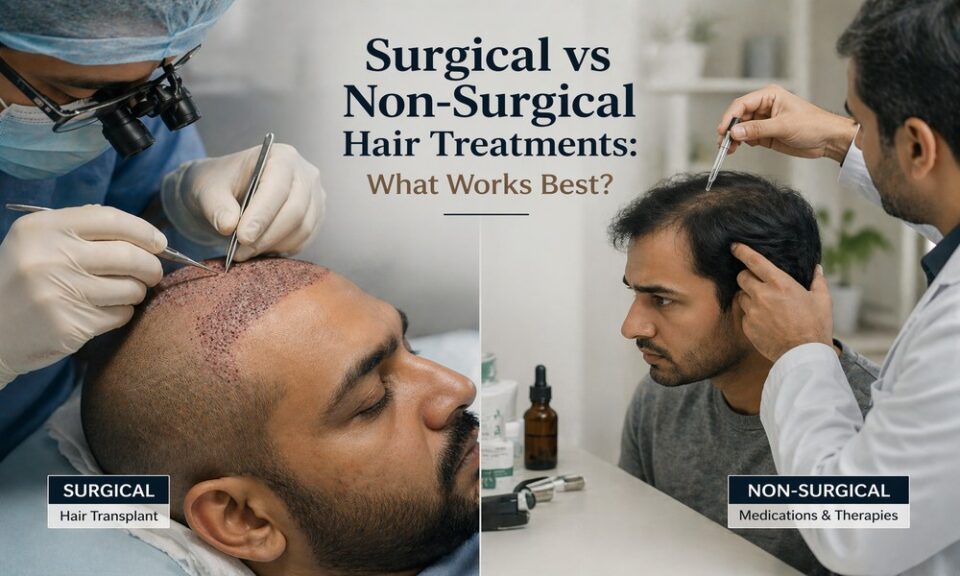
Most patients walk into a hair clinic expecting to be sold one thing. Either a bottle of something to put on their scalp every night, or a surgery that will solve everything in a single morning. The honest answer rarely sits at either extreme.
Surgical and non-surgical treatments are not opposing camps. They are tools at different points on a continuum, and the best outcomes usually come from combining them correctly, not from picking a side.
Where Non-Surgical Treatments Actually Shine
Non-surgical treatments work best when follicles are still alive but struggling. This includes early- to mid-stage androgenetic alopecia, diffuse thinning from nutritional or hormonal causes, post-Covid shedding, and stress-related telogen effluvium.
The evidence-based options in this category include:
- Topical and oral medications that reduce DHT impact or prolong the growth phase.
- Platelet-Rich Plasma (PRP) therapy, which uses the patient’s own growth factors to stimulate follicular activity.
- Growth factor concentrate therapies, a newer regenerative option with cleaner extraction protocols.
- Low-level laser therapy for targeted follicular stimulation.
- Nutritional correction, iron, ferritin, vitamin D, B12, and protein intake.
Non-surgical approaches preserve your existing hair and, in many cases, buy you years. What they don’t do is bring back follicles that have already scarred over or been lost for a long time. That’s a limit worth stating clearly, because patients often spend years on non-surgical treatments hoping for something those treatments were never designed to deliver.
Where Surgical Restoration Earns Its Place
Hair transplantation is indicated when follicles in a specific zone have been permanently lost and medical management has stabilised the surrounding areas. The goal is no longer to save dying follicles, it’s to redistribute living ones.
Modern techniques have become considerably gentler than the strip procedures of the early 2000s. Today’s follicular unit extraction-based methods rely on follicular-preservation through micro-punches, comfort-focused protocols, and precision-placement of grafts that respect the natural angle and density of the patient’s original hairline.
Within this category, Sapphire FUE represents one of the current-generation refinements, using sapphire blades for channel creation that allow denser packing with less tissue trauma. It is not automatically superior for every case, donor density, scalp laxity, and restoration size all influence the choice, but when it fits, it tends to produce cleaner healing timelines.
The Combination Approach
In real-world practice, the patients with the most natural long-term results are rarely those who chose only one option. They are the ones whose clinicians used the full toolkit:
- Medical management to stabilise ongoing loss before any procedure.
- Regenerative therapies in the months leading up to surgery to strengthen donor follicles.
- Surgical restoration planned around a realistic five- to ten-year progression.
- Continued medical and regenerative support after surgery to protect native hair around the transplanted zone.
Specialists at Kibo Clinics often describe this as staged care rather than stacked procedures. The point of staging is simple: you don’t operate on a scalp that is still actively losing hair, and you don’t prescribe medications forever to someone whose pattern has clearly outgrown what medication can hold.
What Actually Works Best: The Honest Answer
Non-surgical treatments work best for early-stage, preventable, or reversible hair loss. Surgical treatments work best for established, stabilised pattern loss in zones where the follicles are genuinely gone. The wrong question is “which one should I choose?” The right question is “where am I on the curve, and what does my plan need to include right now?”
Expert Tip
Ask any clinic you consult with: “If you weren’t allowed to recommend surgery, what would you suggest for me?” The answer will tell you whether they see a full spectrum of options, or only the one they’re optimised to sell.
The Honest Takeaway
There is no universal winner between surgical and non-surgical hair treatments. There are only appropriate tools for specific problems, and clinicians who take the time to match them correctly. When you find a practitioner who explains both routes clearly, and is willing to tell you that neither is right for you yet, you have found the right kind of expert.
